Diversity Ceilidh Resource
The main resource is a database of dances for the 21st Century.
What's this about?
It's about dances that work for the diversity of dancers today. I'm collecting, writing and publishing them in a database
Why is this needed?
A long time ago when "Country Dancing" was "invented", the teachers (known as "callers" today) got people together in coulples, each consisting of a man and a woman. Then they told them to do things like "Men, put your right hands into the middle and dance round clockwise!"
It's not acceptable to many dancers today who want to dance "Gender Free". So why not simply drop the "Ladies and Gents" vocabulary and press on?
Unfortunately, many old dances rely on dancers knowing their gender (and everyone elses) without thinking. (EG: Many dances involve one line of dancers doing something first while the other line go second. Saying "Girls, do this .... now, boys do it is concise and clear, at least to cisnormative people.)
One "fix" for is to talk about the "line on my left" or the "line with their backs to the window" In practice, it often leads to muddle. It also disadvantages those who struggle to process "left" and right" quickly and accurately.
Why are these issues important?
Because they cause discomfort to a substatial number of (potential) dancers. No one enjoys being mis-gendered or being confused about where the left hand of the person on your right is.
The way forward
- There are some old dances that naturally lend themselves to simple calling without using "banned" words. They need more use and promotion
- Some old dances can be changed slightly so as to avoid "banned" words but still not become confusing
- There may be some old dances that are now obsolete
- New dances can be written, suitable for use today
That's why we have collected a database of dances suitable for use today
More detail and background
Three issues come up time and time again:
Struggling with (anti)clockwise
It is expected that dancers know clockwise from anticlockwise which disadvantages upwards of 50% of dancers. Fortunately its impact is low because many dances that need to specify the direction of rotation are less common.
Confusion over Left and Right
It is expected that dancers know left from right. Not just their left and right but the left and right side of other dancers. Around a third of dancers are disadvantaged to some extent and for some. it has a significant impact, especially when they are expected to understand a sequence of lefts and rights.. (See much more detail on Left/Right Confusion in Dancing)
Gender Issues
Traditional dances assume men are partnered by women and that everyone can identify another dancer as male or female instantaneously. This challenges the idea of "gender free dancing" that has come to the fore in recent years. The extent to which it is "needed" depends on context. EG:
- In Queer Ceilidh, it's very important
- Many non-LGBTQIA+ dancers prefer gendered role names, especially if that's what they've been used to for many years
- Some festivals mark individual dances as using gendered or gender-free calling
What's been done?
For some years, many callers have been careful to avoid using ""Ladies" and "Gentlemen" and refered to the line on the left/right, perhaps abreviating them to "Larks" and "Robins". Unfortunately, this has made things harder for those with Left/Right Confusion. Also, the verbal gymnastics needed to avoid "banned" words risk making the instructions more complicated and confusing. Another approach is "positional calling" teaches dancers about their positions rather than their roles. It can work moderately well until people get out of position and then it may be chaotic,
The best way forward is to fix the actual dances - that's what the database is about
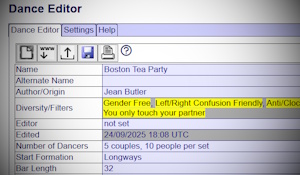
- We've also creatred a Dance Editor tool. Initially for use by us to produce the data on this site, it's now available to the public. To get started, contact us for a login.
- We're keen on sharing dances and data with other people and websites. As a start, it's quite easy for software engineers to extract dance data from our pages, especially if they read this first.
Who are you?
I'm Steve Harris. I've been dancing for over 35 years and spent over 8,000 hours on dance-floors noticing what goes right and what goes wrong. My "calling" history is less extensive but I do know a lot more than many callers.
