How it worksThis move is definitely from when diversity wasn't even on the horizon. It's worth describing the move using left and right because it's quite easy to do so and illustrates some of the issues that avoiding Left/Right Confusion brings. There are some gender issues too.
The classic move involves a longways set, traditionally a line of men facing a line of women
The top couple grasp each others right elbow and rotate 1.5 times
This ends with both members of the top couple heading towards the #2 person in their partner's line who they give their left arm, rotate and go back to a right hand swing with their partner at the centre line of the set
The move then repeats with couple #3 involved, etc.
A "handy tip" for this dance is that it's "right to your partner and left on the side" which is obviously not LRC Friendly. Another that works in Gendered settings is that all the arming is with someone of the opposite sex. I even used to tell people "Stick to the opposite sex, you'll have more fun, trust me, I'm a dancer!"
Both of these "clues" probably should be relegated to the rubbish bin of history. It's challenging but possible.
How it can go wrongThere are several way this move fails in practice - paticularly with beginners. Some of them matter while others don't
The #1 couple only rotate once around instead of 1.5 times. This leaves them stripping the "wrong" line. In many modern settings, this is pretty harmless. However, some (mainly older) men don't like dancing with other men. For more about this issue, see here.
One member of the #1 couple tries to strip with the "wrong" line while their partner gets it "right". This results in both trying to strip with the same side person. It's somewhat chaotic. The cause seems to be the erroneous dancer turning round
When one member of the #1 couple takes "too long" to strip their person on the side and partner comes back to the centre "too early", the "too early" partner goes direct to stripping the next person in their side line. When the "too long" person finally arrives in the centre, their partner is no longer there. This can become a bit chaotic.
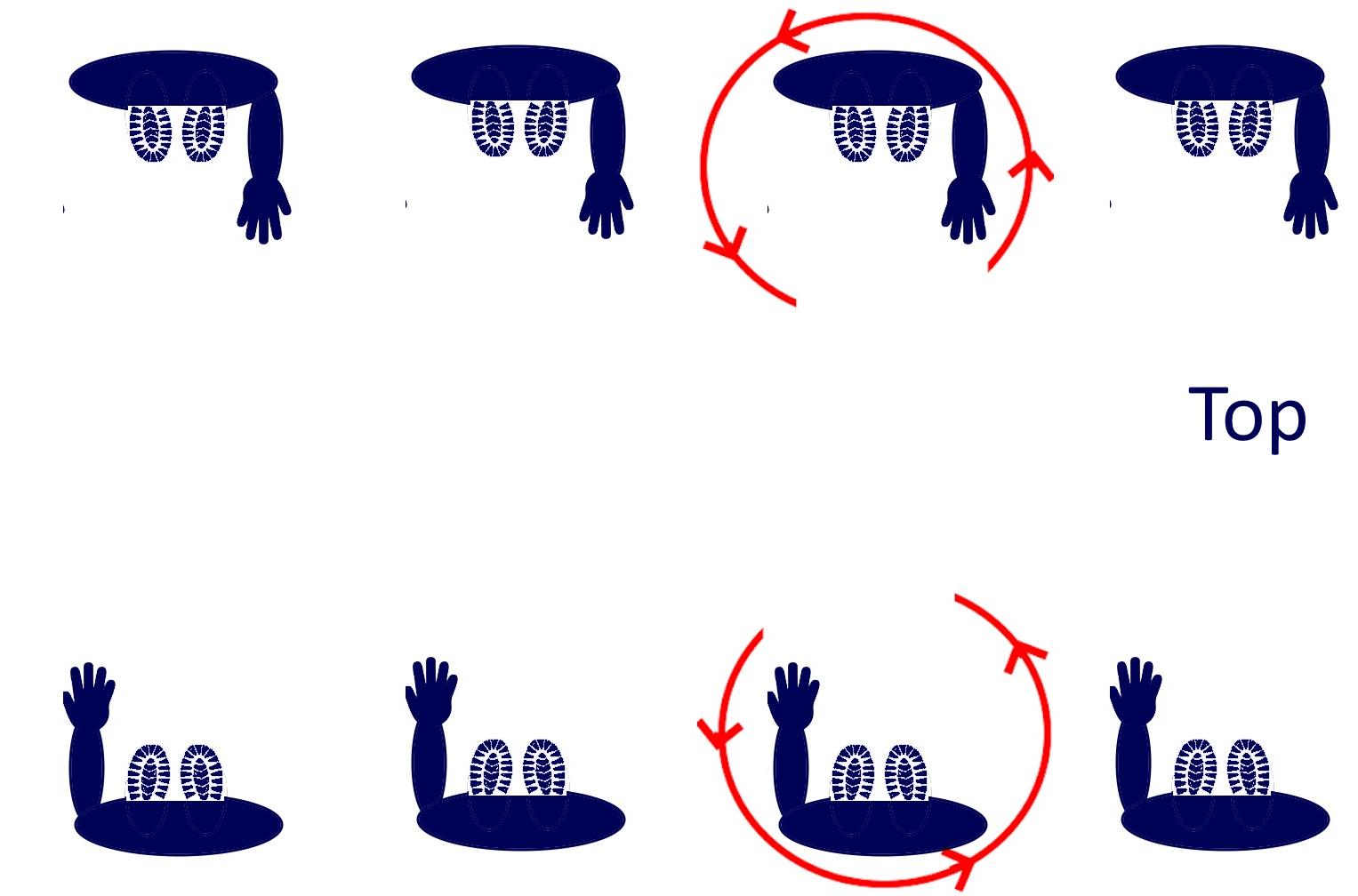
So, while none of the above issues is fatal, it may trigger "helpful" people to intervene. Perhaps the only effective help is to tell the person who is stripping you "next time, other line" or "you're doing it right". The move is not symeticalAlthough the standard instructions (of various types) imply that everybody is doing the same thing, it's not so! Some callers suggest that the couples other than the top/working couple hold out an appropriate hand . the diagram below shows this together with part of the route the stripping couple takes in red.
This shows that another way of describing what the stripping couple do would be to say that they're both going anticolckwise around the side couples. Unfortunately, "anticolckwise" is not an easy concept for a large number of people.
Tell the working couple to reach out to each other as if to shake hands but to grab their partner's elbow instead
Tell the oither couples they're going to be using their left hands only for this move. Ask them all to wave their left hands hold them a little bit forward and ready
Working couple now rotate 1.5 times, detach and head for the next person in the opposite line. Link arms with them and rotate going behind them and come back in to link arms with your partner.
Hint to working couple: You are always alternating arms
Working couple now "strip" couple #3 in the same way as #2